
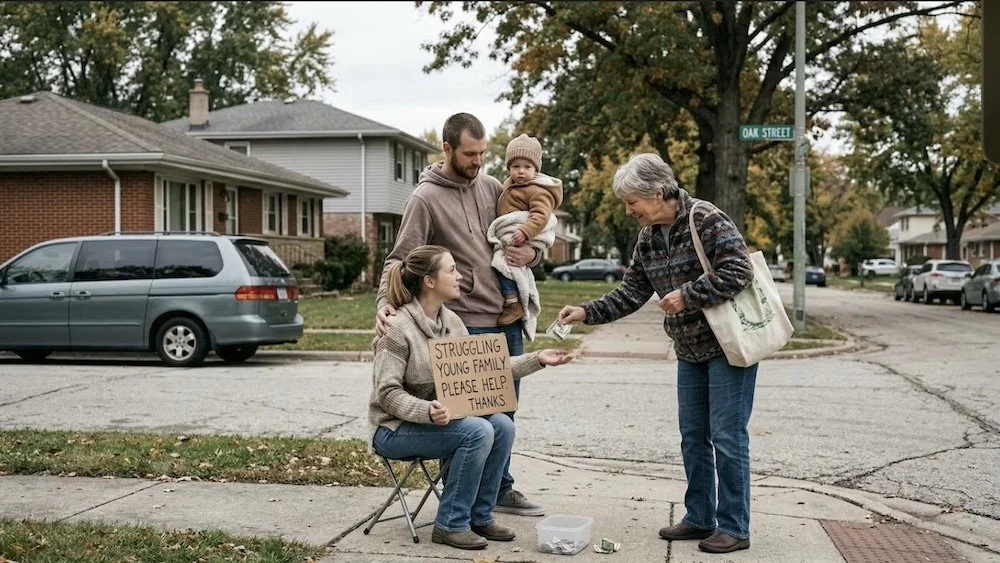
So can the Community Housing Providers save the day?
Disclaimer
While every effort has been made to thoroughly research the New South Wales Government’s legislation on in-fill housing and to try and accurately summarise it in a manner for residents to understand, we are not legal experts, it is complex legislation and you should not rely on this as being what the legislation actually says, Click here for full disclaimer
What is Affordable Housing?
Under the SEPP, one option for the provision of affordable housing is to set aside a 10% – 15% of apartment’s GFA and give over the apartments allocated to that area to a Community Housing Provider or CHP for 15 years (see below). The CHP then makes these available to very-low, low and moderate income earners at a discount - say 80% of the market rent or for 30% of the household income. After 15 years the apartments can revert to the open market. It is this definition that is used in most DAs. No developer is submitting plans with studio or 1-bedroom apartments that ordinary young people might afford and become home-owners. This model of affordability only offers these hopefuls a lifetime of being at the mercy or ever-rising rents.
What is the Affordable Housing Bonus?
The Affordable Housing Bonus is earned when 10%–15% of the GFA is set aside to be managed by a CHP for at least 15 years – the Floor Space Ratio (FSR) bonus. In inner zones (up to 400m away from our designated town centre, maximum of 22m or about 6 storeys, up to 800m away from our designated town centre, maximum of 17.5m or about 4 storeys). The bonus allows the developer to add 20%-30% to the floor space, in the case of apartments by making the building 30% taller – hence 6 floors can go become 8 or 9, therefore allowing high-rise building to be built in areas designated as mid-rise.
Once one or more 9-storey buildings are built in an area designated for “low to medium rise” housing, does the area “de-facto” become a high-rise area?
Who is Eligible for Affordable Housing?
Affordable Housing assistance is available to Very Low, Low and Moderate income households. It offers rent at a lower price than usual market rent through a CHP. Affordable housing is open to a broader range of household incomes than social housing, so you can earn more income and still be eligible. Rent is also calculated differently and there are different tenancy arrangements.
For 2025-26 in Sydney…
Very Low is for up to 50% of the median income ($61k PA or $1173 PW)
Low is 50% – 80% of the median income (up to $98k PA or $1885 PW)
Moderate is 80% – 120% of the median income (up to $148k PA $2846 PW)
In addition the NSW Government website lists the following eligibility criteria… Whether:
▪️you are a citizen or permanent resident of Australia
▪️your household is be able to find suitable or adequate housing privatly
▪️you own any assets (eg. a property) to address your housing need
▪️you can show that you are able to maintain a successful tenancy
In the NSW Affordable Housing Ministerial Guidelines, allowance is made for households with more than one adult plus children to cater for the increased expenses associated with more people in the household. Table T1 below shows earning bands for Sydney. Regional NSW has different bands and is not covered here.
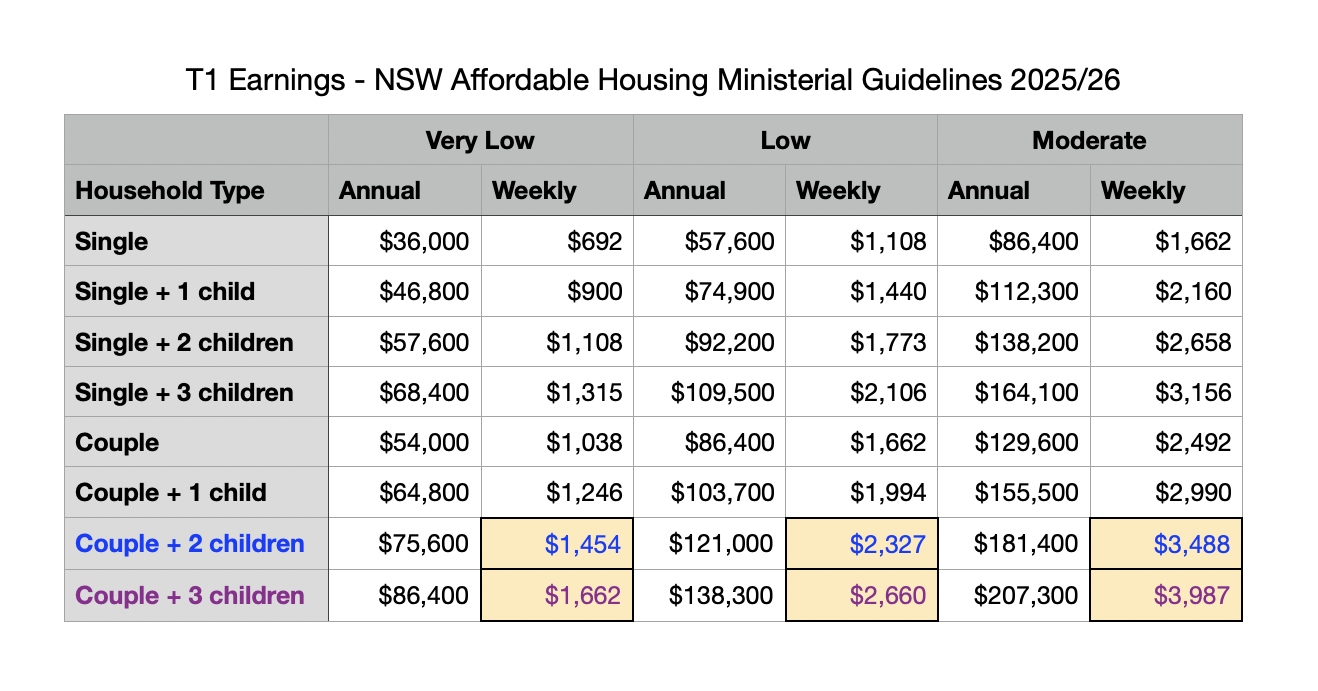
In the tables below that look at rental for “Very-low, Low and Moderate income households” it is assumed that
▪️Couple with 2 children would rent a 2-bedroom apartment
▪️Couple with 3 Children would rent a 3-bedroom apartment
What is a CHP and how is it funded?
CHPs are registered non-government, mostly not-for-profit organisations that own, manage, or develop affordable and social housing for low-to-moderate income earners. In NSW, there are over 230 registered CHPs and they are regulated under the Community Housing Providers National Law (NSW) 2012. Funds come from government subsidies, rents, and private financing.
It is not clear how they would select tenants for these SEPP/LMR luxury developments. Business logic suggests that a shortfall between the Government Subsidy and a tenant’s income would play a part in deciding who is offered a lease, thus favouring Moderate earners over Low or/and Very Low earners.
One CHP we contacted replied that tenant eligibility, rent setting, allocation and ongoing compliance are regulated under the NSW Affordable Housing Ministerial Guidelines and overseen by the NSW Registrar of Community Housing.
Example 1 – Nurses
Interestingly when people talk about affordable housing they immediately give essential workers like Nurses, Teachers, Police Officers, Fire Fighters, and Paramedics as examples who need such housing. Whilst there are references to specific projects on the NSW Government’s web site that seek to provide housing for essential workers, there is no specific mention of them in the eligibility criteria in this legislation.
Table T2 looks at weekly wages for Nurses with 1, 4 and 8+ years of Registration as per the PUBLIC HEALTH SYSTEM NURSES’ & MIDWIVES’ (STATE) AWARD 2023 against Low, Median and High Rentals in Drummoyne as per the NSW Governments Rent Check portal
New apartments in Drummoyne, especially those alongside the Parramatta River (as most DAs we see are) would be at the very top of the High range that Rent Check is reporting – they are brand new, they are described in the brochures as luxury and they are near the waterfront (the cells highlighted in yellow).
In the tables below, any rental that is less than or equal to 30% of a renter’s income is highlighted in green
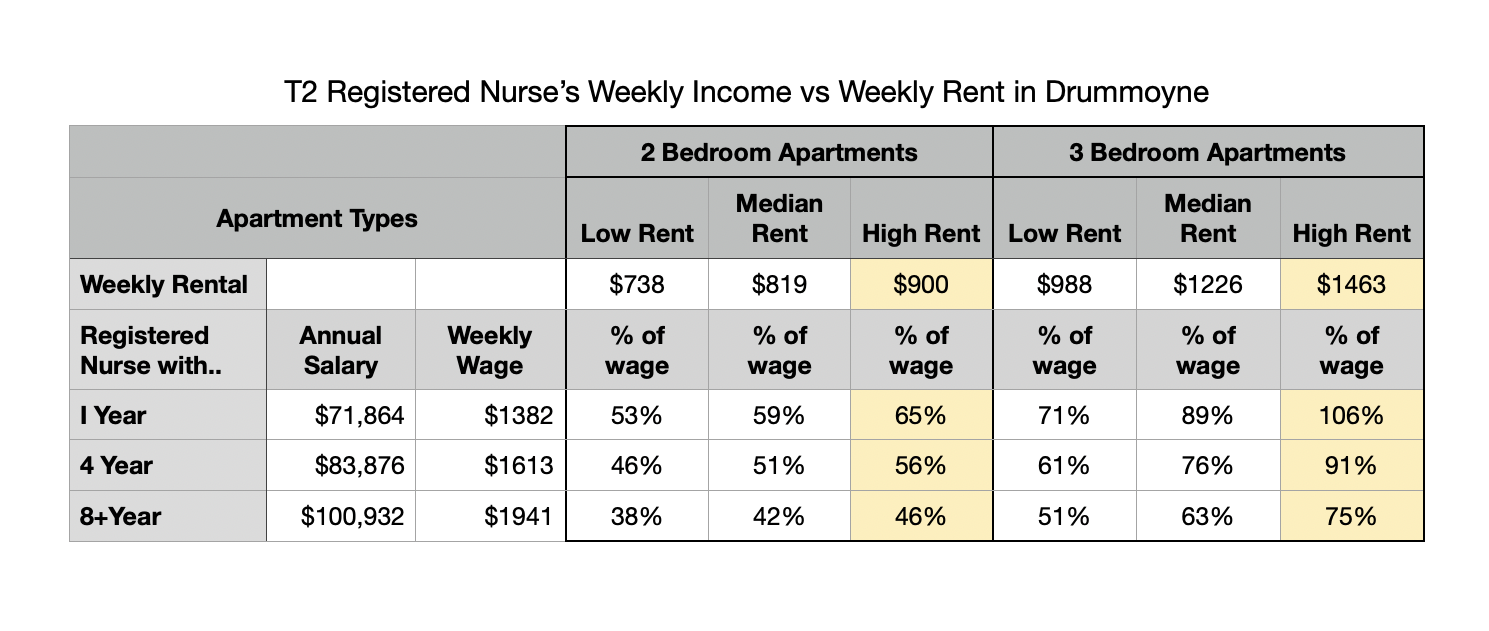
Without a rent subsidy, no apartment in Drummoyne would be affordable by any Registered Nurse as rental should not exceed 30% of one’s income.
Example 2 – Very Low, Low and Moderate earning households
Table T3 looks at the same rental market from the point of view of Very Low, Low and Moderate income earners.
For this analysis it is assumed that couples with 2 children will likely seek 2-bedroom apartments and couples with 3 children will likely seek 3-bedroom apartments
The cells highlighted in yellow with Blue text represent income for a Couple with 2 children
The cells highlighted in yellow with Maroon text represent income for a Couple with 3 children
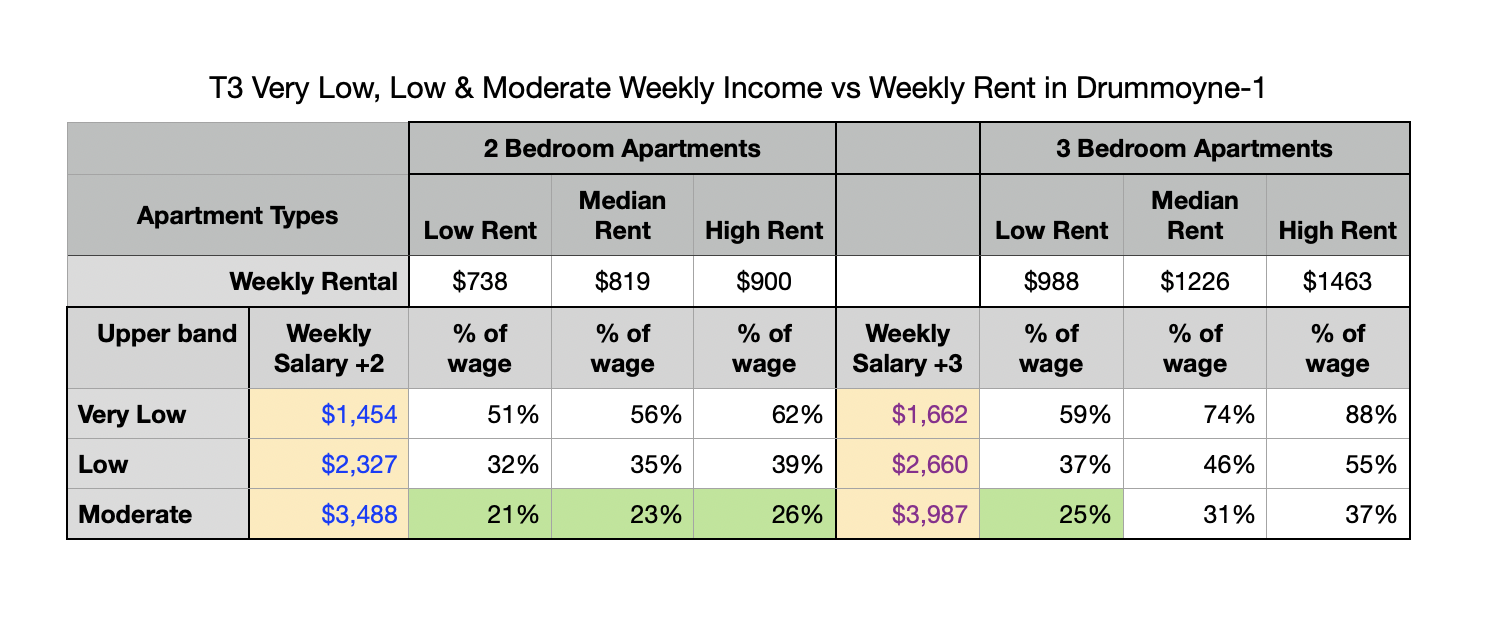
Only households on a Moderate salary ($180k a year / $3,488pw for a couple with 2 children) would find any 2-bedroom apartment affordable in Drummoyne (one that does not exceed 30% of their income).
In the case of 3-bedroom apartments, it is only low end rentals that a Moderate salary household ($207k a year / $3,987pw for a couple with 3 children) would be able to afford in Drummoyne.
It is also interesting to note that spread in price between Low and High Rental in the 2-bedroom category is much narrower than in the 3-bedroom category, suggesting that there is some marked difference in the housing stock for those 2 categories. Possibly High Rental 3-bedroom apartments are more modern and aimed at wealthier clients than older 2 bed-room apartments.
Table T4 looks at the sorts of apartments being made available to the public through SEPP’s projects. These are new, described as luxury, are in prime locations and so cannot be anything other than at the High Rent end of Rent Check’s price range. On the left and centre is rental that is discounted to 80% of its open market value (the renter pays 80% of the market value) and on the right is rental that is discounted to 30% of the renter’s income (the renter pays 30% of their income). It looks both at affordability for the Nurses and for Very Low, Low and Moderate households (the same groups we looked at in Tables T2 and T3 above) and at a CHP's losses depending on which of the two subsidies it offered.
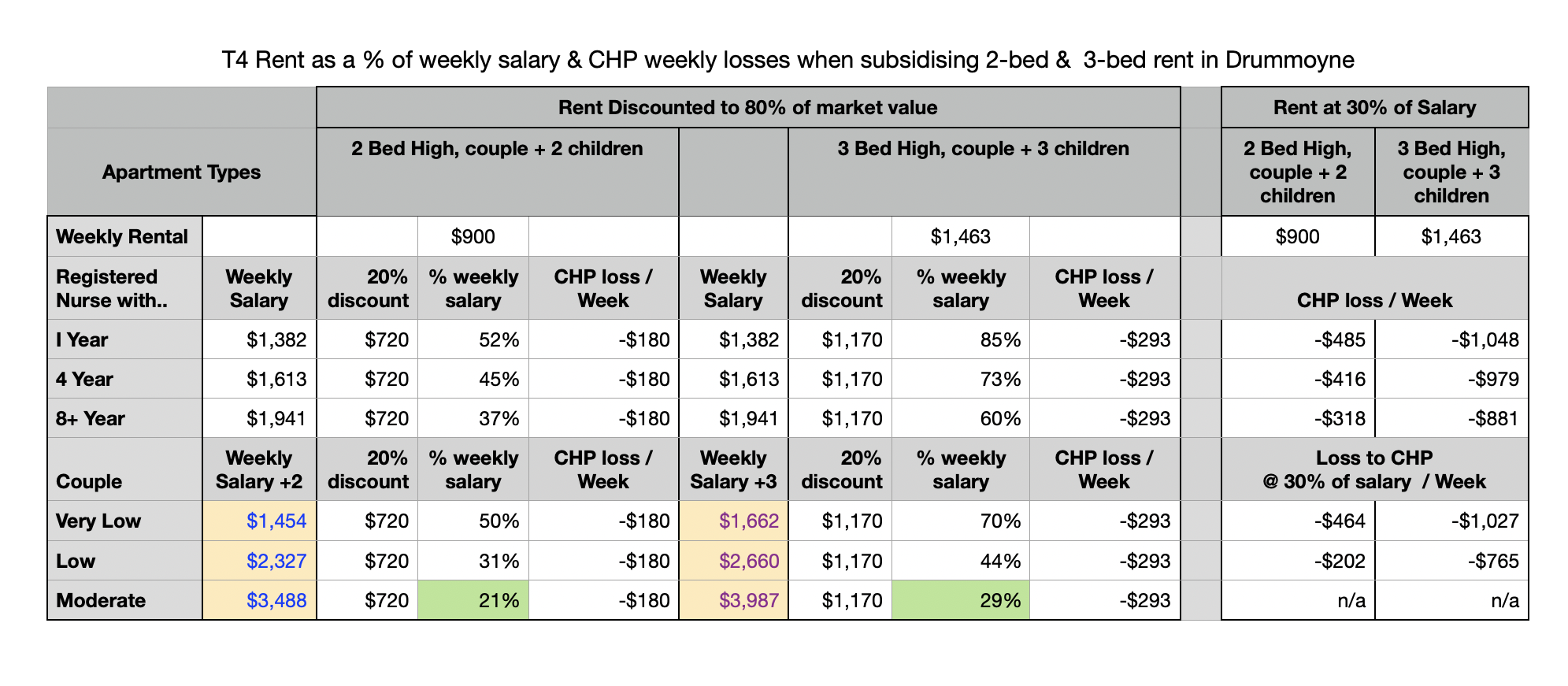
Looking at the table above, it is hard to see why a CHP would offer anything other than reducing the rent to 80% of market rate with the CHP paying 20% as the subsidy. Subsidising any tenant on the basis of them not paying more than 30% of their income would result in a bigger loss to the CHP – this they would have to cover from their government subsidies and private funding. The NSW Affordable Housing Ministerial Guidelines say in Section 1 that — A secondary aim of the Guidelines is to ensure that retained earnings and assets from managing affordable housing are used by community housing providers to grow more affordable housing supply, wherever possible.
So there is an efficiency incentive stated right at the top of The Guidelines that seems hard for a CHP to ignore and so from a simple financial perspective it is hard to see how
any lower earning household would get preference over a higher paying household
how any apartment could go to a Low or Very-Low paid household unless the CHP allowed the renters to only pay 30% of their income as rent
What about the housing stock being built?
No DA lodged with the city of Canada Bay since late in 2025 offers studio or 1 bedroom apartments, some offer 2-bedrooms and some only offer 3-bedrooms. Most claim a 30% height bonus on the strength that they are setting aside 15% of the GFA to be managed by a CHP and are therefore providing affordable housing – remember for that 15% they get a 30% height bonus. The eligibility criteria are broad enough to allow a single person to apply, but without studios and 1-bedders to house them in, taking on single people as tenants would be underutilising a valuable resources and would deprive more deserving applicants. That class of single people is a significant section of the population who are totally excluded from SEPP affordable housing.
So with none or very few non-luxury apartments being built, there is no real affordability on offer even with a CHP to take some of the rental burden.
Conclusion
It would seem that CHPs will not save the day as they are likely to pick the best salaried applicants and leave those who are the most needy out in the cold. If they offer subsidies to poorer renters on the basis of 30% of what they earn, CHPs will not be able to “grow more affordable housing supply” because that requires surpluses.
The affordability and housing crisis will will continue to get worse without an overall design ethos that specifically focuses on “people and households in need” and demands that the housing being built under SEPP can be mostly targeted at that in-need sector, housing that can be afforded without subsidies, housing that can put people on a direct path to home ownership.
Allowing developers to build view-hungry luxury apartments under this "banner of “affordable housing” is so clearly the wrong thing to do if you are trying to address housing affordability.
Disclaimer
While every effort has been made to thoroughly research the New South Wales Government’s legislation on in-fill housing and to try and accurately summarise it in a manner for residents to understand, we are not legal experts, it is complex legislation and you should not rely on this as being what the legislation actually says,
All information on the Site is provided in good faith, however, we make no representation or warranty of any kind, express or implied, regarding the accuracy, adequacy, validity, reliability, availability, or completeness of any information regarding the laws of New South Wales. We undertake no liability to you for any loss or damage of any kind incurred as a result of the use of this site or reliance of any information provided on the site. Your use of the site and your reliance on any information provided on the site is solely at your own risk.