
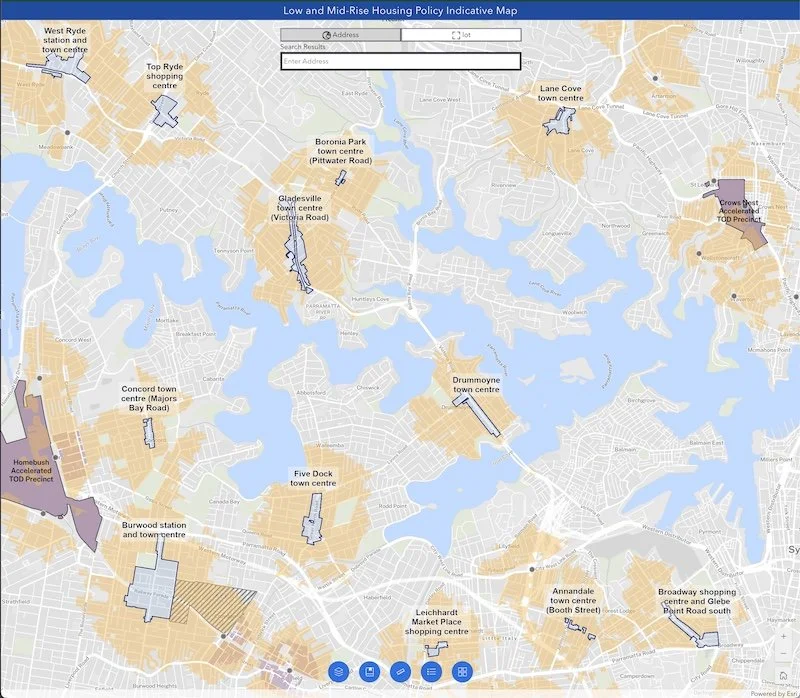
There are 171 LMR areas in the Sydney Region
LMR, SEPP, SSD – what you need to know
Unlike other areas, over 90% of our suburb is designated an LMR area – Low and Medium Rise
Disclaimer
While every effort has been made to thoroughly research the New South Wales Government’s legislation on in-fill housing and to try and accurately summarise it in a manner for residents to understand, we are not legal experts, it is complex legislation and you should not rely on this as being what the legislation actually says, Click here for full disclaimer
How LMR applies to Drummoyne
The NSW Government has introduced State Environmental Planning Policies (SEPPs) to create in-fill areas (the pale orange areas on the maps above and below) where medium density housing (apartment blocks) can be constructed and sets out standards that they must or should adhere to. This streamlines and speeds up the approval process for these types of developments with the power to override Local Government provisions.
The map below shows that around 90% of Drummoyne is a designated LMR area with a large part of that being Inner Zone – 400m walking distance from the town centre (in grey) and the rest being Outer Zone – 800m walking distance from the town centre.
In these zones, normal height limits can be increased by 20% – 30% if 10% – 15% of the Gross Floor Area (GFA) of a development is set aside for affordable housing for a minimum of 15 years.
Inner zones allow buildings with up to 6 floors (or up to 8/9 if affordable housing is included)
Outer zones allow buildings with up to 4 floors (or up to 5/6 if affordable housing is included)
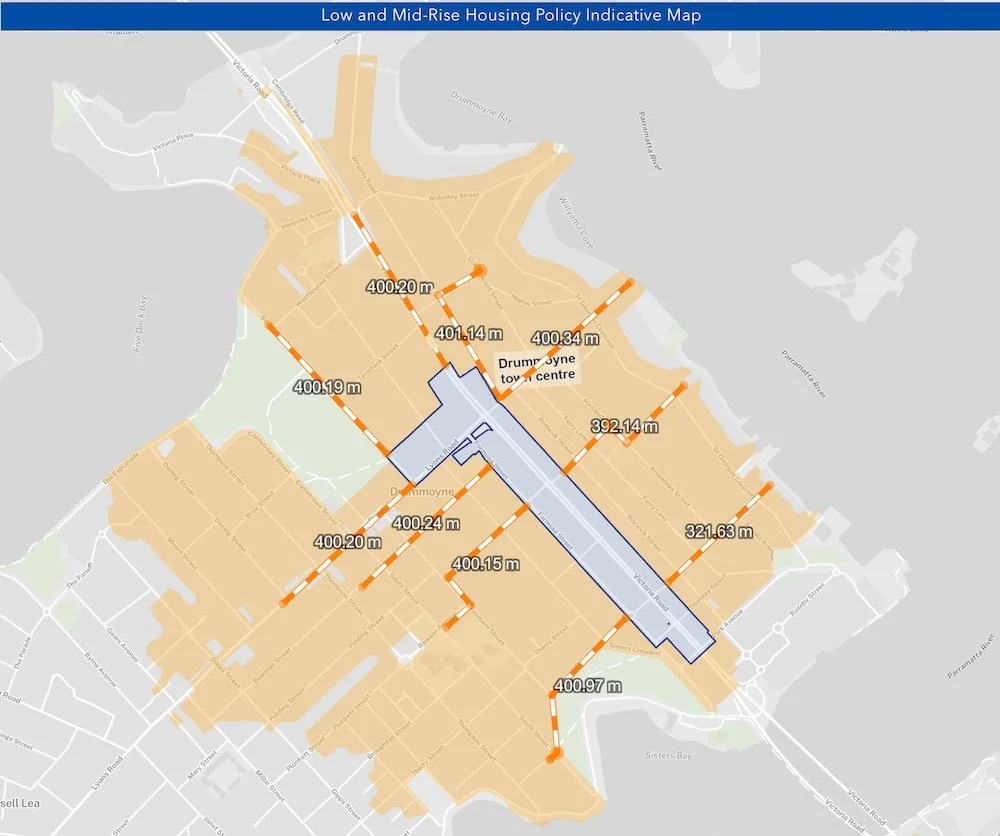
The image above was taken from the NSW Government’s spatial portal. The orange-white dotted lines are drawn with its measuring tool. They are 400m long walking distances.
Given the above, developers now have the “right” to build 8 to 9 floor apartments in most of Drummoyne and 5 to 6 floor apartments absolutely everywhere in the orange zone.
This right comes without any consideration for the suburb’s lack of infrastructure to support the increased density – additional transport, sewerage, parking, schools etc
How the law overrules local planning
While SEPP seems to be drafted with the aim of providing diverse and affordable housing with minimum adverse local impact, in practice the proposed cases we are seeing and those approved by the NSW Government instrumentalities seem to violate the preamble of the legislation and its own design guidelines. Developers (a) see the very attractive profit margin in high-end dwellings, (b) have the legislative framework that lets them by-pass council planning laws, (c) have additional financial incentive to build taller than before (d) cherry-pick parts of the legislation that best suit profit margin (e) while seeking exemptions from conditions that that add to their costs such as studio and 1 bedroom flats, appropriate setbacks etc. The end result almost always makes a mockery of the government’s own guide-lines for these projects. Don’t blame the developers – if someone hands you a goose that lays golden eggs with few strings attached why wouldn’t you take advantage of it?
LMR was not presented to Parliament for any kind of debate, it is considered a form of delegated legislation made by the Governor in Executive Council, and does not require review by Parliament.
On one hand this by-passing of parliament for such a far-reaching set of laws seems somewhat undemocratic and drastic, but the justification might be that the current housing shortage and affordability crisis is extreme and it needs to be solved quickly rather than be debated endlessly.
On the other hand without considered master-plans for these in-fill areas, ad-hoc projects driven by how developers can make the most profit are going to result in chaos and poor outcomes for the neighbourhoods in which they are built. And future generations of residents will rightly hate us for allowing that to happen.
New housing is not an option, it is a very real requirement. But it needs to be tackled responsibly, for the benefit of the existing residents, the new residents and those who will live here long after we have gone. Yes build it in my back yard but don’t turn the suburb into a disaster area.
If you feel powerless and squeezed by the pace of submission and seemingly mechanical approval of new Development Applications (DAs) as a result of the State Government’s SEPP legislation there are three things you can do:
1. Let the the Premier, the Minister of Planning, their opposition counterparts, your local member and your council know how you feel. Write and tell them that rapid development without a Master-Plan that includes infrastructure to support the extra density will be a disaster and you will hold them responsible for that at the ballot box.
2. Look for and sign ePetitons to the NSW parliament on the topic or start your own
3. Look for and examine the DAs lodged with your council and have your say.
Without your active engagement and feedback, you can’t complain if your neighbourhood changes in ways you find incomprehensible or unacceptable.
What can you do?
Write to: the Premier and the minister for planning.
NSW Premier, Chris Minns
NSW Minister for Planning & Public Spaces, Paul Scully
Copy to: the NSW opposition, your federal & local member, the Mayor and your council
NSW Opposition Leader Kellie Sloane
NSW Shadow for Planning & Public Spaces, Chris Rath
NSW local member Stephanie di Pasqua
Federal local member Sally Sitou
City of Canada Bay Mayor Michael Megna
Canada Bay Council
Fill in the ePetition on the NSW parliamentary web-site to save genuinely affordable housing from new planning rule exploitation - open until 31st July 2026
Look for open ePetitions at the NSW Government’s Legislative Assembly Portal
Look for DAs at Canada Bay Council’s DA Tracker > Agree to the Terms > You can then search for them by DA or by property address
Does LMR and SEPP result in more genuine affordable housing or is it driving up prices?
Read more here…
Disclaimer
While every effort has been made to thoroughly research the New South Wales Government’s legislation on in-fill housing and to try and accurately summarise it in a manner for residents to understand, we are not legal experts, it is complex legislation and you should not rely on this as being what the legislation actually says,
All information on the Site is provided in good faith, however, we make no representation or warranty of any kind, express or implied, regarding the accuracy, adequacy, validity, reliability, availability, or completeness of any information regarding the laws of New South Wales. We undertake no liability to you for any loss or damage of any kind incurred as a result of the use of this site or reliance of any information provided on the site. Your use of the site and your reliance on any information provided on the site is solely at your own risk.